
Savoring the Solitude
Theological Paradoxes and Reflections for Holy Saturday

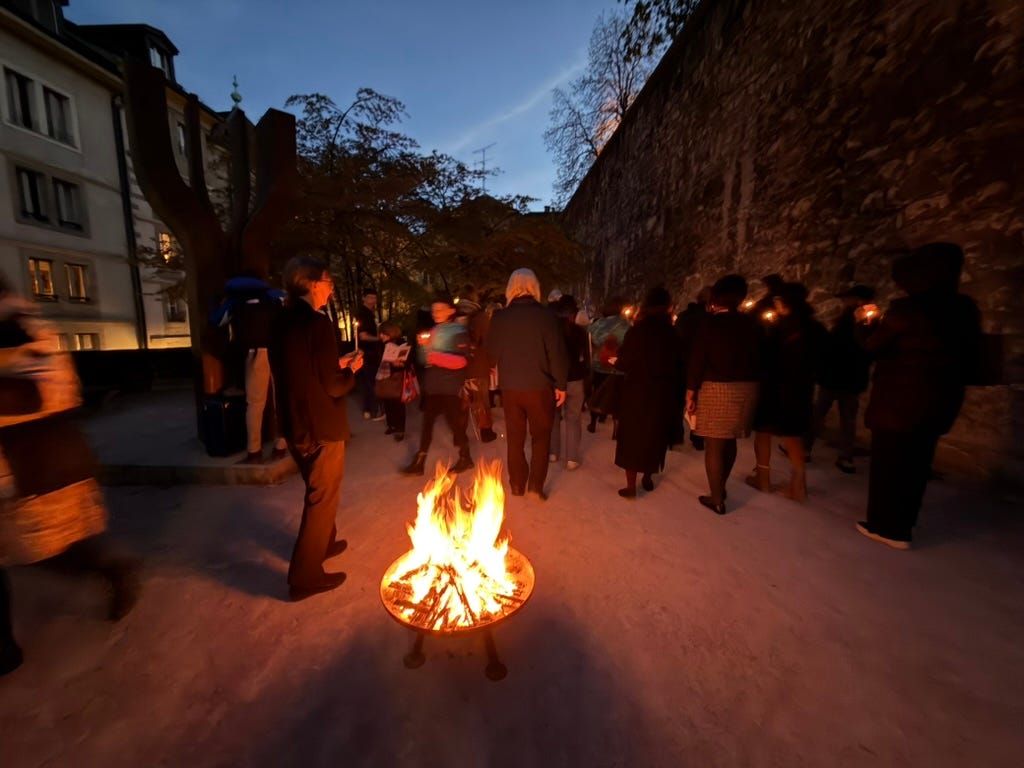
Holy Saturday has arrived. I sat at the corner of the sanctuary at the Evangelical Lutheran Church of Geneva. We were preparing for the Easter Vigil service. The choir practiced a little dance that would end the service; they continued tuning their harmonies for songs we would join in later. I could hear the arrangements of the communion cups and jugs for wine and grape juice in the sacristy behind me. I lifted my head. Quite a few people were trickling in. Some smiles here and there and a hug or two. A celebrative mood is already in the air. But for the moment, I was sitting here savoring the solitude in the midst of the surrounding activity.
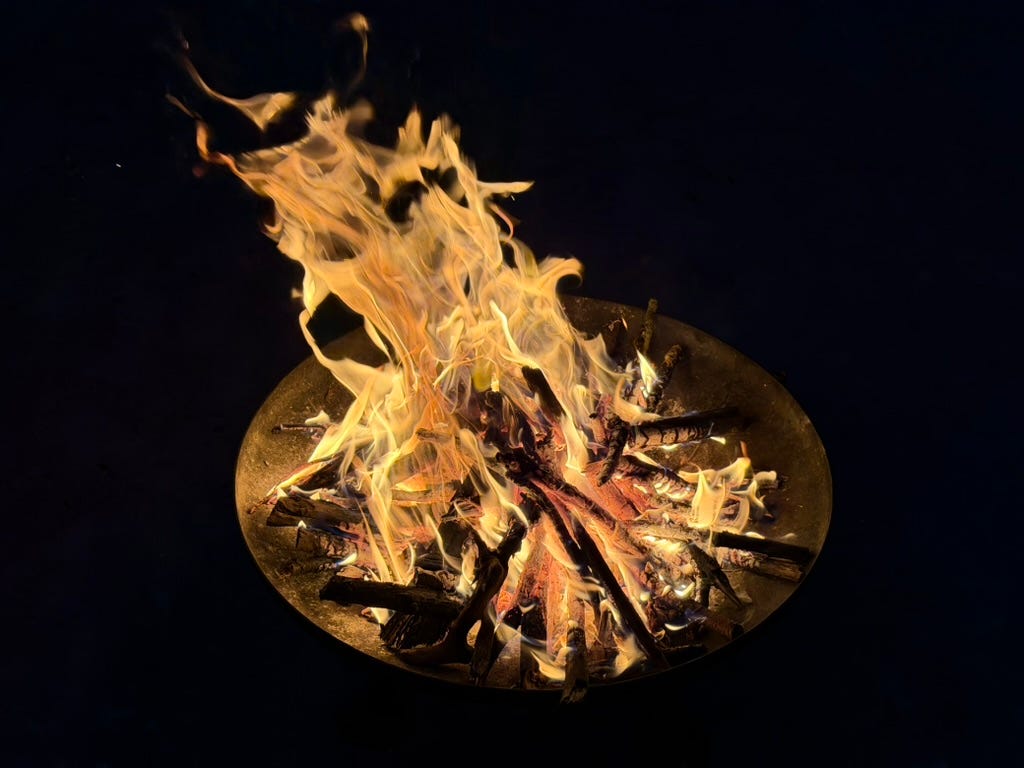
We moved up nearby the stairs where the fire would be lit. It was 8:30PM in the evening. The sky was already quite dark. When the fire was lit in the middle, the warmth and light were inviting. We gathered around as a group but also as individuals. My heart gradually shifted from sitting alone to being part of a community standing together. Voices sprang into song about the light of Christ. The light from the center spread from person to person, candle to candle, without diminishing. We moved slowly as one in procession, entering the church with little flames, leaving behind the single flame that started it all. Then we stepped into the worship hall one by one, regathering again with the song of the light of Christ, leaving the darkness outside.
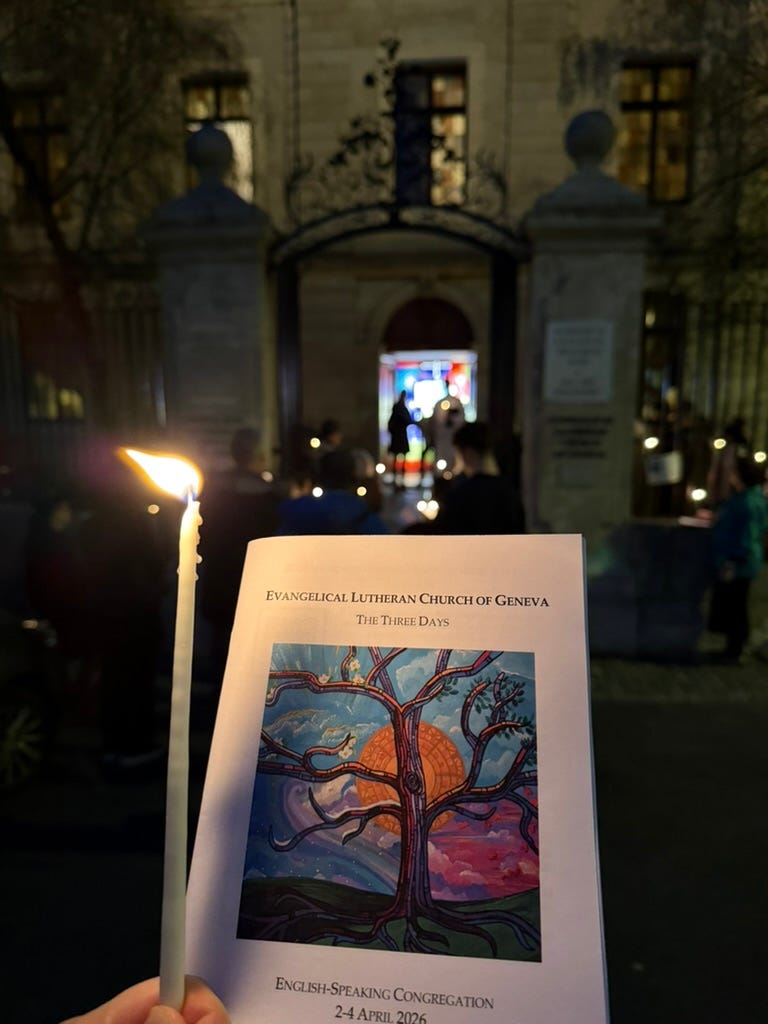
Distrusting completely our own wisdom, according to that counsel of the Holy Spirit, "Do not rely on your own insight" [Prov. 3:5], we humbly present to the judgment of all those who wish to be here these theological paradoxes... — Martin Luther (Heidelberg Disputation, preface, 1518)
How often have we trusted our own intelligence and abilities to judge and figure out the way the world works with our analytical tools? We spend energy to resolve contradictions and to solve problems. Reading Luther's preface causes me to pause: to embrace and welcome theological paradoxes. I receive these two theses anew to shape my heart and mind on a day between the cross and the empty tomb.
In Thesis 20, Luther writes:
One deserves to be called a theologian, however, who comprehends the visible and manifest things of God seen through suffering and the cross.
What does it mean to be a theologian of the cross? Looking back in different moments, the wounds of walking our family through that valley of the shadow of death, haunted by the horrors in the face of death because of illness and the ongoing lingering challenges of health until now, remind me again and again where God is most visible and revealing God’s self—truly through suffering and the cross.
Personally, even when I struggle, I want to open myself to receiving what might be most surprising and unexpected through the pain and suffering of others beyond the news reports to the personal encounter, whether it is the sharing of discrimination and displacement from a corner of northern India or being in the midst of our prayer meeting with our brothers and sisters in the Holy Land, whether it is in my home or the land where Jesus walked. I don’t think I have it all organized and sorted out easily. I hold this paradox in life, work, and my theological thinking, and I’m committed to engaging with it.
Luther continues in Thesis 21:
A theologian of glory calls evil good and good evil. A theologian of the cross calls the thing what it actually is.
I don’t use the word "heresy" lightly. What I saw on the news—a group of Christian leaders surrounding a powerful president, glorifying the power, the raw power of what is experienced by others as empire and imperialism, with war in front of our minds, in front of our faces, and then hearing a reference linking a powerful ruler’s experience to Jesus’ suffering, death on the cross, and resurrection—was deeply disturbing. The scene was not a paradox, but an absolute contradiction. At least to me, it was a contradiction to what the gospel really means. I worry the damage to the Christian witness and the wound inflicted on those who are considered the ‘other’ are even deeper. Some forms of Christianity today are not sound. They wound, they diminish, and they even kill.
And yet at the same time, I want to hear and name what is most essential: the cross brings to light the one who was afflicted, wounded, and died for us all—especially those who are named as the 'others.' To the powerful, these people are mere numbers of casualties and less than human, though created in God's image and likeness. But through the lens of suffering and the cross, they too are God’s beloved.
So I carried fragments of these thoughts when I started reading from the book of beginnings—Genesis chapter 1. The words repeated: it was evening, and then it was morning. The first day. Night before day. The second day … and repeated, step by step, steadily towards the seventh day, interspersed with congregational participation of sounds and gentle movement. We heard about the formless void, emptiness, or even absence of God. Yet we also heard how God's creative work progressed: movement by movement, step by step, with paradoxical weight. All of this is happening, slowly but steadily. All good. It landed with “very good.”
After the reading, I followed the movements of the liturgy in song, in readings, and in liturgical action. There was a clear movement from darkness to light. The littlest festive mood before the service began to enlarge itself by the time we reached alleluias enveloping the sermon and hallelujahs sung throughout Holy Communion. We were ready to enjoy the Easter Feast. The liturgy in this Easter Vigil service already moved us all toward the Easter resurrection. I must admit that I wasn’t quite ready. My body and soul were still in Holy Saturday while the liturgical service moved into Sunday. I felt I was still dwelling in between—kneeling before the cross and anticipating the empty tomb. The liturgy was right and correct. It was just that this time my body and mind were not fully there yet. The Alleluia came.
By the time May Chin and I returned home, I was ready to rest and sleep. It was a good time. And like the seventh day where God rested, where things felt finished, the day rightly concluded.
But on Holy Saturday I am learning to dwell in a space for honesty and humility. To stop resolving and solving. To let a holy moment of paradox stand.
This is the ninth post in my Lent 2026 series. Previous posts include: Blessing the Dust,
Moving Forward While Reading Backwards,
The Heartbeat of the Week: Pray and Work,
Words That Stay With Me,
Seven Movements of Renewal,
Scattered and Gathered,
From the Tower to the Table,
and Between the Shadows and the Sun.