A Meeting Without PowerPoint
Ideas are free. Implementation is costly. What about impact?

We sat around a rectangular white table. The big screen was on my left, but I was determined we didn’t need another PowerPoint presentation. What mattered to me was the whole face-to-face encounter.
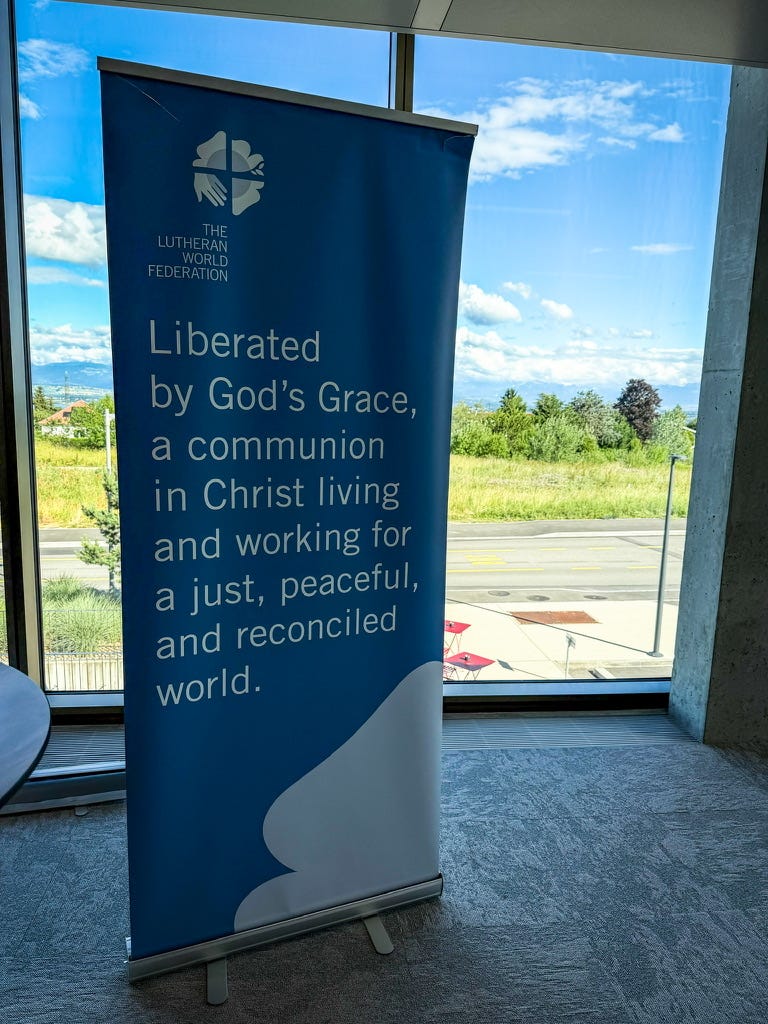
We met in Lund, one of the conference rooms named after our first assembly location, at the Lutheran World Federation Communion Office. Four of us from the Department for Theology, Mission and Justice management team were having a conversation with a presiding bishop accompanied by a close colleague.
It was a quiet room. We started with introductions, and these carried something biographical too: roots in Kenya, Finland, Germany, and my own Malaysia. Each of us had spent years in different arenas: humanitarian work in South Sudan and Darfur, serving as a missionary in Thailand, years away from home for doctoral studies in Norway, advocacy work in Geneva, and a wide range of experiences elsewhere. It was a good way to begin, and it let the rest of the conversation become exactly that — questions, clarifications, and dialogue.
At some point, the presiding bishop asked for something more concrete. Stories. Something tangible that he could share with others. How does the work of theology, mission and justice actually impact people on the ground?
The conversation was free-flowing back and forth, compact with information about the work we do, and near the end, I offered a line I’d been using throughout the LWF Council meeting that had just finished: ideas are free, implementation is costly. And then, because stories were what we talked about quite a bit, I was inspired to finish the sentence that has been hovering on my lips the past week: Impact needs stories. That’s how I landed it, at the close of the conversation before lunch.
But the last part of the sentence lingered with me afterward. Something about it didn’t fully settle. I kept turning it over. Impact needs stories. It wasn’t wrong, but it didn’t quite fit either. What felt closer to true was stories show impact, not impact needs stories. And the more I sat with that small difference, I realized the whole conversation hadn’t actually been searching for a better sentence about stories at all. There was something underneath it.
Our work, captured by the four programs (Theology for Transformation, Leadership for Thriving Churches, Churches for Diaconal Action, and Action for Justice), is more than numbers and finances. It’s the people who implement the ideas. Humans embody them, carrying out the costly actions; they are being impacted and being changed by how the ideas are practically realized in concrete situations. Embodiment happens at the level of the idea, at the level of implementation, and, most importantly, at the level of impact. This impact aligns with the LWF strategic priorities: Responsible Theology, Thriving Churches, Dignity and Service, as well as Justice and Peace. This is the language that preoccupied us during the recent LWF Council meeting. When I revisit the full list in this paragraph, I can picture the people whom my colleagues serve through these programs.
Yet the word that transcends all the above, the word that kept returning to me, was embodiment. It’s been on my mind for a while now. Partly because of the AI conversations happening everywhere. Partly because of Pope Leo XIV’s Magnifica Humanitas, with its emphasis on the human being made in the image of God and on human dignity in work and labor. What does it mean to highlight the human being in an age that keeps threatening to reduce us to abstraction? How do we avoid being caught between AI anxiety and excitement over technologies that risk costing us sight of our own humanity? I thought, too, of embodying hope, a phrase from the LWF Global Mission Consultation a little over a year ago. I’m reminded of the men at the pre-council meeting also appreciating a no-PowerPoint meeting that was focused on sharing about transformative leadership and the formation of how we were all shaped to become who we are today. “God is not finished with you yet” was a big takeaway for us. This was a phrase one of the men had carried since he was young, and as he shared it, it rippled through the room, impacting all of us who were there too.
So after ruminating on it for a while, the line finally settled here: ideas are free, implementation is costly, impact is embodied. Not embodied in a report. Not in a number. But in people and in communities on planet Earth.
What does that actually look like? It looks like the Global Mission Consultation in Taiwan a year ago and Rodolfo, a young person from Bolivia who represented his whole region in shaping the consultation’s thinking. He also brought what he learned back home, and now he’s applying it in his small church in Bolivia. It looks like a Ukrainian refugee, a woman who was able to get a driver’s license and move freely in her host country.
The programmatic person in us or donors might ask, “Is this the best use of the money or resources for maximum impact? Are these the right people to focus on?” Those are necessary questions. But they’re not the most important ones. Before that, we need to ask something more fundamental: what does this mean for the person on the receiving end of the support and the accompaniment? Because that’s where the impact is actually embodied.
This made me think about the comments I heard during the Council this year. There were reasonable comments about saving money, having fewer meetings, doing more online, cutting days, and cutting costs. And there were Council members who pushed back, who said that meeting one another matters, that something is lost when we don’t. This was already in the air for the people around the room. I wonder what the people whom we serve might say to us if they were there in the room.
What struck me was where each kind of comment came from. The efficiency language and the sustainability questions tend to come from consultants and donors from our related organizations and from staff like me, whose job is to think about resources and how we can be good stewards. That’s our natural constraint. But the Council members entrusted with actual governance don’t just read the reports. They reach for the story instead and dig deeper beneath the surface to that which is more lasting. They reach for an encounter. Both the efficiency question and the embodiment question need each other. We have been challenged on this since the COVID-19 pandemic. We have been forced to find new ways to do things online, and some of it works well, with gains and losses. But at the end of the day, we still yearn for an embodied experience, a face-to-face encounter with another human being. High tech will never replace the human touch that we don’t want to lose.
That’s what made the end of our meeting in the Lund conference room so fitting. I said, with a tinge of humor, that we never got around to a fancy PowerPoint. There was real appreciation in the room that it was nice to have a meeting without one. That was the whole point. It wasn’t about a polished presentation. It was about the impact that comes from an embodied encounter through conversation, through shared values and stories, and through deep engagement whenever it’s possible. We may not have covered everything we wanted to. But what we were looking for was more than information. We were looking for impact both in others and within us.
This isn’t an either-or. We still need information, reports, accountability, and strategy. There’s a place for all of that. But this is a question of reordering what matters most. Once that reordering happens, I think we’re moving in the right direction.
At least, that’s what I keep being reminded of, again and again. For now. And I believe it’s something I’ll keep probing deeper in the days to come.